

Overview
Alephant is an Agentic Finance Gateway for production agents and workflows. The AI Gateway is the model-access layer inside that platform: it gives agents one reliable way to call models while Alephant applies routing, policy, tracing, cost attribution, and financial controls around the full agent run.
Instead of wiring every agent or application directly to every provider, teams connect once and route across 50+ providers, 320+ models, and custom model backends. Start with Alephant Cloud for a managed workspace, or self-host the gateway when you need private infrastructure, BYO keys, and direct operational control.
OpenAI compatibility is the entry point, not the product boundary. A request can still look like a standard /v1/chat/completions call, but Alephant can attach that request to an Agent ID, Run ID, session, policy decision, budget, cache event, request log, payment event, and margin record.
Why this exists
AI applications are moving from single-model prototypes to agents and workflows that call models, tools, APIs, and paid endpoints. Without a gateway, every team ends up rebuilding the same operational layer: provider adapters, routing rules, key management, usage metadata, retries, caching, and request logs.
Alephant AI Gateway centralizes model access behind one developer-friendly API, then connects each request to the broader Alephant control plane. Developers keep a familiar SDK integration while platform and finance teams get policy before provider access, traceability before incidents, cost attribution before budget reviews, and revenue visibility when agent capabilities are sold as paid endpoints.
The goal is simple: make agent activity observable, governable, reliable, and financially accountable without slowing developers down. Learn more ->
Features
Developer surface
Architecture & request lifecycle
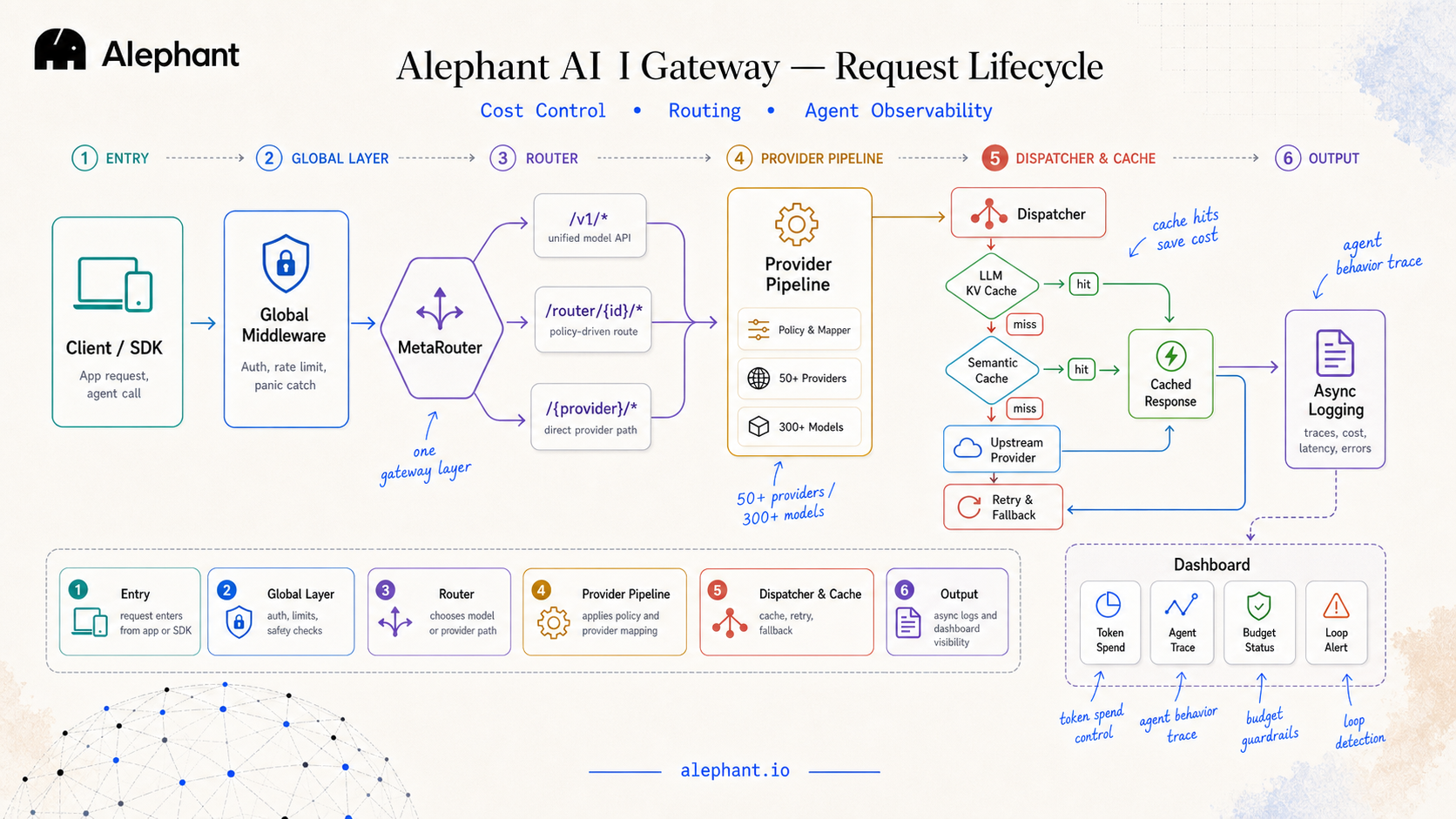
Every request passes through the same gateway lifecycle: authentication, agent context, policy checks, routing, provider mapping, dispatch, cache, fallback, and async logging. The entry path depends on how much control you want:
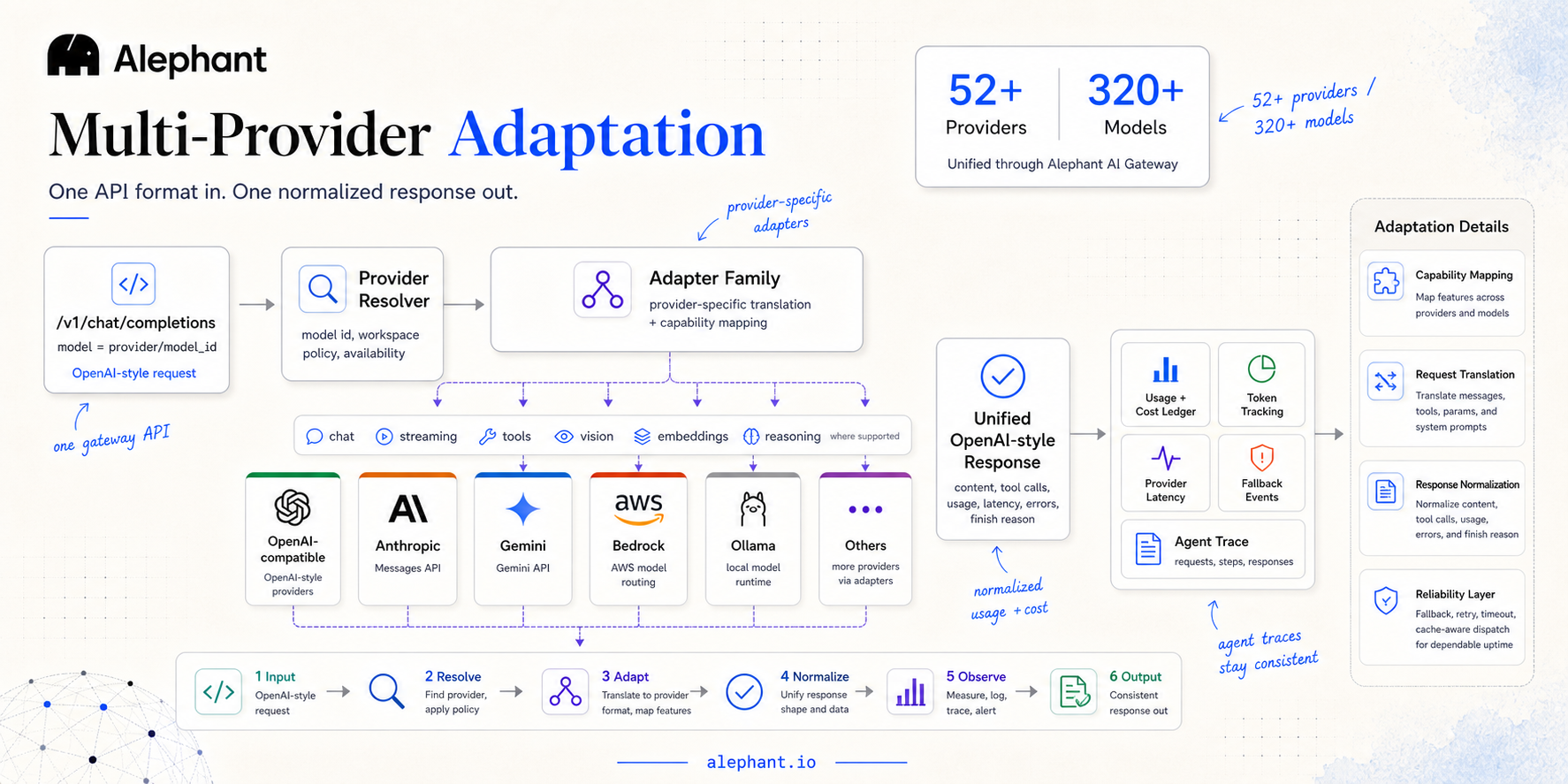
Multi-provider adaptation
Use one familiar request shape across 50+ providers and 320+ models, including OpenAI-compatible APIs, Anthropic Messages, Gemini, Bedrock, Ollama, OpenRouter-style catalogs, and custom backends. The client selects a runtime with model=provider/model_id; Alephant resolves the provider, applies the right adapter, maps provider-specific fields, and returns a normalized response.
Instead of listing every model in the README, this section focuses on the contract: one request format in, one consistent response out. The provider and model catalog can evolve independently without forcing application code changes.
IDE integration
Alephant AI Gateway ships repository-level tooling for AI-assisted development inside supported IDEs.
Comparison
Portkey, Helicone, and LiteLLM are excellent projects, but they start from different centers of gravity. Alephant is built for teams shipping agentic AI products: a hosted SaaS workspace plus a self-hosted gateway path for agent governance, run tracing, model routing, cost control, and agent monetization.
Alephant’s differentiator is the combination: hosted SaaS, self-hosted Rust gateway, agent-first developer compatibility, run-level governance, BYO-key control, explicit provider adaptation, AI FinOps, and payment-aware monetization.